Why does air quality matter?

Air quality starting to degrade on a winter morning.

Numerous studies have confirmed a multitude of serious health complications caused by exposure to poor air quality. Here is a brief overview of some of the main health implications.
(There is an increased focus on fine dust (particulate matter), because in Almaty, PM2.5 is the biggest concern, followed by PM10, especially in the winter months.)
According to research (see below):
- PM2.5 is capable of entering the circulatory system and even the brain.
- Short term symptoms of exposure to high levels of particulate matter include irritation of the throat and airways, coughing, and difficulty breathing.
- More serious, long-term complications can include:
- heart and lung disease
- asthma, bronchitis, decreased lung function
- nonfatal heart attacks
- irregular heartbeat
- early death
- People with heart or lung diseases, children, and older adults are most likely to be affected by particle pollution exposure.
- Air pollution has been linked to higher risk of young children developing asthma.
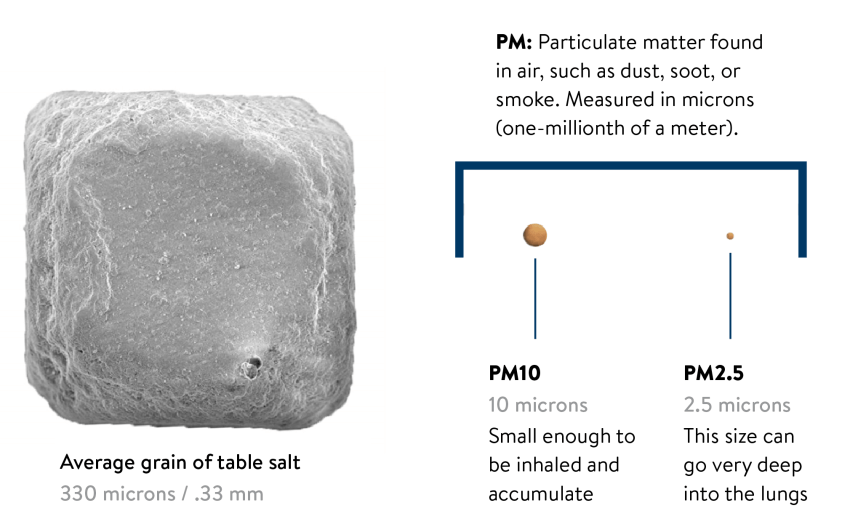
Relative sizes of fine air particles. Source
Children
Children are particularly vulnerable to the health effects of air pollution, as their bodies and immune systems are still developing. According to research (see below), the
health implications for children specifically include:
- Development of respiratory illnesses, such as asthma, bronchitis, and pneumonia.
- Permanently reduced lung function and growth.
- Increased risk of disease, allergies, and respiratory infections.
- Brain damage and related cognitive and behavioral issues.
For more information about the negative effect of low air quality and some research behind this, the following links might be a good place to start.
Particulate Matter – PM 2.5
- WHO (World Health Organisation) - Outdoor air pollution
- IQAir - About PM2.5
- CDC (Centers for Disease Control and Prevention, USA) - Particulate Matter
- EPA (US Environmental Protection Agency) - Health and Environmental Effect of Particulate Matter
- What is PM2.5 and why does it matter?
PM 2.5 and children
- Air pollution linked to higher risk of young children developing asthma
- Long-term exposure to PM2.5 and children's lung function
- Air pollution damages brains, as well as hearts and lungs; reduces cognitive funtion
- Fine particulate matter exposure during childhood relates to hemispheric-specific differences in brain structure
⟵ |
⟶ |